

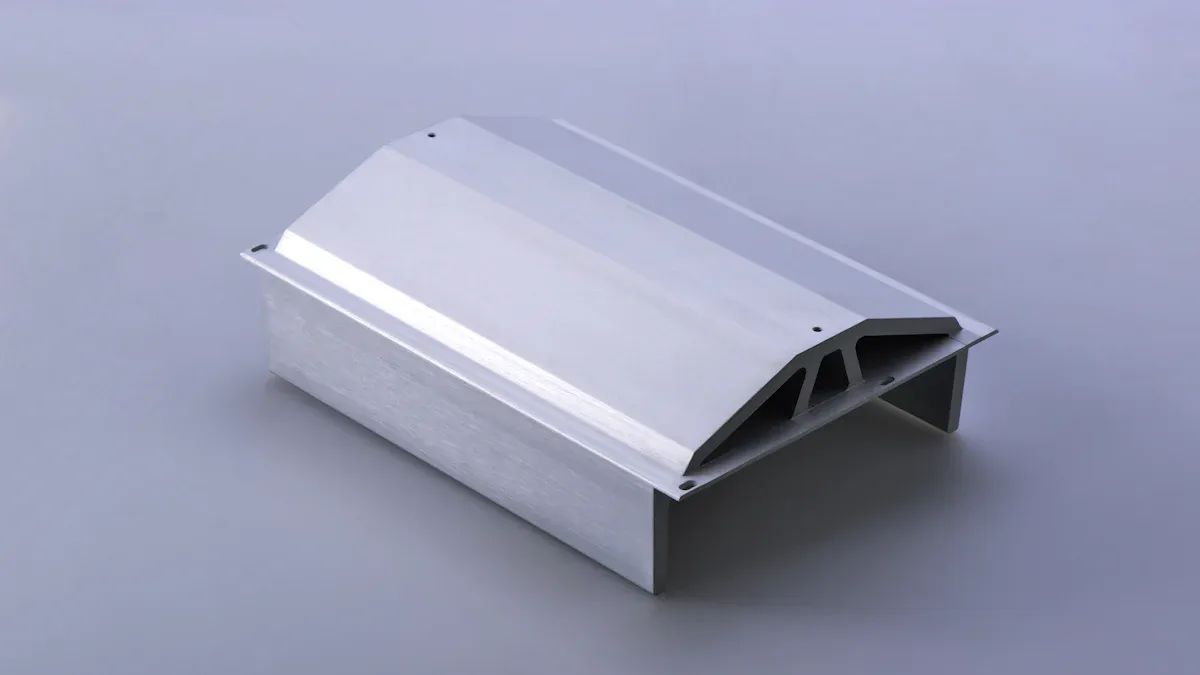
When I choose High Foaming PP ProfileMaterial, I pay close attention to my specific needs and the end-use environment. I value lightweight strength, insulation, and chemical resistance. Reliable suppliers matter to me, as do certifications. The automotive industry leads in usage, as shown below:
| Industry | Market Share (%) |
|---|---|
| Automotive | 42 |
| Packaging | 31 |
| Consumer Goods | 19 |
Key Takeaways
●Identify your application needs before selecting high foamed PP profiles. Consider factors like load capacity, insulation requirements, and environmental conditions.
●Choose the right foam type for your project. Closed-cell foam offers high strength for structural uses, while open-cell foam is ideal for cushioning.
●Always check the supplier’s reputation and certifications. Reliable suppliers ensure quality and compliance with industry standards.
Define Application Needs
Load and Structure
When I select High Foaming PP ProfileMaterial, I always check how much weight it needs to support. I look at the foam type because it affects strength. Closed-cell foam gives me high load-bearing capacity. It resists compression and works well for structural parts. Open-cell foam feels soft and compressible. I use it for cushioning, not for heavy loads. Here is a table that shows the differences:
| Foam Type | Load-Bearing Capacity | Characteristics |
|---|---|---|
| Open-Cell Foam | Low | Compressible and soft, ideal for cushioning but not suitable for heavy loads. |
| Closed-Cell Foam | High | Denser and more rigid, resists compression, suitable for structural applications. |
Environment and Insulation
I consider the environment where I will use High Foaming PP ProfileMaterial. In construction, I use it for insulation panels, wall cladding, and roofing. It keeps temperatures steady and saves energy. In cold and humid places, I need good insulation. The material has low thermal conductivity, usually between 0.030–0.040 W/(m·K). Some types reach 0.028 W/(m·K) with special agents. I also check moisture resistance. The material absorbs less than 1% water after 24 hours. It keeps its insulation even in humid conditions. I use it for wall insulation, roof insulation, and underfloor heating.
Aesthetic and Sustainability
I pay attention to how the material looks and how it affects the environment. High Foaming PP ProfileMaterial comes in many colors and shapes. I can match it to my design needs. I also value sustainability. The material is recyclable and safe for the environment. I use it for packaging, food trays, and medical supplies. It protects products and resists chemicals. I choose it when I want both good looks and eco-friendly features.
High Foaming PP ProfileMaterial Criteria
Density and Foaming Agent
When I choose High Foaming PP ProfileMaterial, I always check the density first. Lower density means lighter weight, which helps in applications like automotive and packaging. I look for profiles with densities between 0.3 and 0.7 g/cm³. This range gives me a good balance between strength and weight. The foaming agent matters too. Physical agents like CO₂ and nitrogen create uniform cells. Chemical agents can give me different cell sizes and densities. I select the foaming agent based on the end-use. For insulation panels, I prefer agents that produce fine, closed cells. For cushioning, I pick agents that make larger, open cells.
Tip: Lower density profiles save material and reduce transportation costs. I always match the density and foaming agent to my application needs.
Mechanical Strength and Cell Structure
I pay close attention to mechanical strength. The cell structure inside High Foaming PP ProfileMaterial affects how strong it is. Smaller cells and higher cell density improve flexural strength and toughness. I compare different resin types to see which gives me the best performance. Here is a table that shows how cell structure impacts mechanical properties:
| Resin Type | Cell Density (cells/cm³) | Cell Size (μm) | Flexural Strength Improvement (%) | Flexural Modulus Improvement (%) | Toughness Decrease (%) |
|---|---|---|---|---|---|
| Resin A | 620 | Larger | N/A | N/A | N/A |
| Resin B | Lowest | Largest | N/A | N/A | N/A |
| Resin C | 173% higher than A, 887% higher than B | 22% smaller than A, 46% smaller than B | 17% higher than A, 6% higher than B | 52% higher than A, 11% higher than B | 79% lower than A, 37% lower than B |
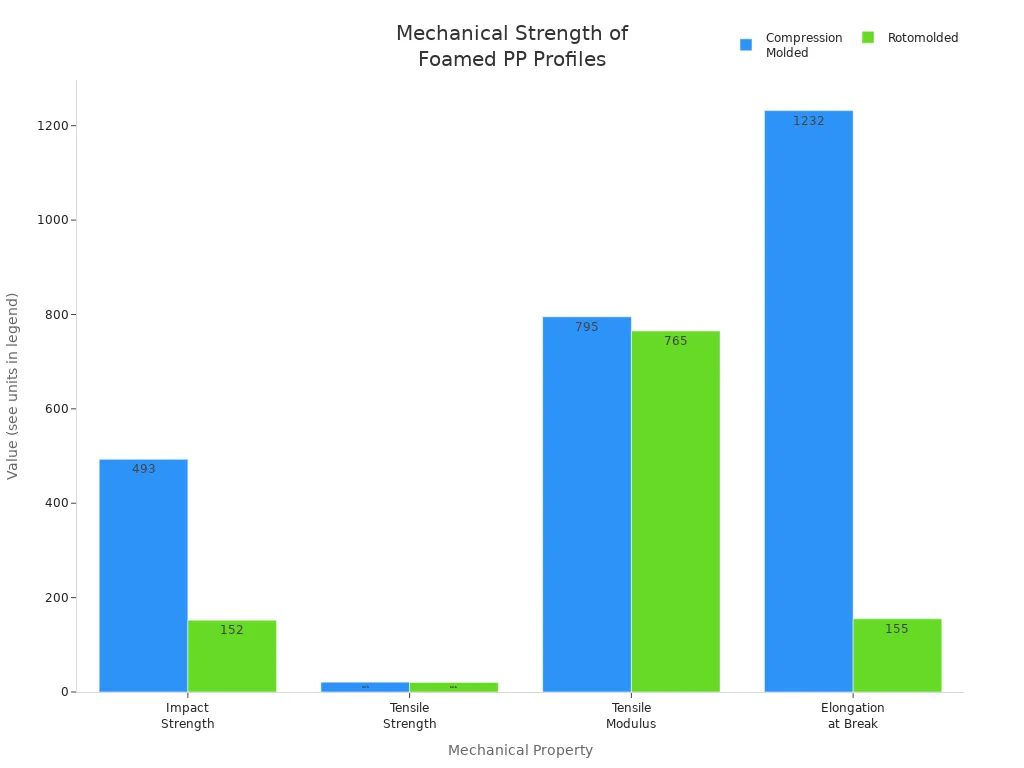
I also check the manufacturing method. Compression molded profiles have higher impact strength and elongation at break than rotomolded ones. I use compression molded profiles for parts that need to absorb shocks. Here is a chart that compares mechanical strength:
Thermal and Chemical Resistance
I always test thermal and chemical resistance. High Foaming PP ProfileMaterial keeps its shape in temperatures from -20°C to 100°C. This range works for most industrial and consumer uses. The material resists acids, bases, and solvents. I use it in environments where chemicals might spill or leak. For insulation, I check the thermal conductivity. Values between 0.030 and 0.040 W/(m·K) mean good insulation. I pick profiles with the lowest thermal conductivity for energy-saving projects.
●I use High Foaming PP ProfileMaterial in labs, kitchens, and outdoor settings because it resists chemicals and heat.
●I select profiles with high thermal resistance for roofing and wall panels.
PPI and Air/Water Flow
I look at PPI (pores per inch) when I need filtration or controlled airflow. Higher PPI means finer filtration. Lower PPI allows more air or water to pass through. I choose High Foaming PP ProfileMaterial with 20–60 PPI for air filters. For water filtration, I pick profiles with 60–100 PPI. I always match the PPI to the filtration needs.
Note: I test samples to make sure the PPI meets my requirements for flow rate and filtration efficiency.
Recyclability
I value sustainability. High Foaming PP ProfileMaterial is fully recyclable. I collect used profiles and send them for recycling. This reduces waste and supports eco-friendly practices. I check if the supplier offers recycling programs. I use recycled profiles in packaging, automotive, and construction. Recyclability helps me meet environmental standards and lowers costs.
●I choose profiles with clear recycling codes.
●I ask suppliers about their recycling process.
Compare Options and Select
Supplier and Certification
I always start by checking the supplier’s reputation. Reliable suppliers give me consistent quality, on-time delivery, and clear communication. They also guarantee that their products meet industry standards. I look for suppliers who can prove their quality with certifications. Here are the main certifications I check:
| Certification Type | Description |
|---|---|
| ISO 9001:2015 Certification | Ensures quality management and customer satisfaction, providing assurance of product quality. |
| UL Product Certification | Recognizes component materials, potentially reducing testing costs and time for final products. |
| NSF/ANSI/CAN-61 Product Certification | Ensures compliance with health and safety standards for drinking water system components. |
Customization and Cost
I often need custom shapes, sizes, or properties for my projects. New manufacturing technologies, like automation and advanced cross-linking, let me get more options. These improvements help me match the material to my needs. However, I know that more complex designs and special equipment can raise the cost. I always balance my need for customization with my budget.
●Automation and cross-linking give me more choices.
●Special designs and equipment can increase the price.
Sample Testing and Evaluation
I always request samples before making a final choice. I test the foam’s cellular structure and impact resistance. Finer and more even cell sizes improve ductility and toughness. Better foam quality means better performance in my application. I use these tests to compare brands and pick the best one.
Tip: I focus on samples with small, uniform cells for higher impact resistance.
Decision Checklist
Before I decide, I use a checklist:
●Check supplier reputation and certifications.
●Review customization options and costs.
●Test samples for structure and strength.
●Match the profile to my application needs.
This process helps me choose the best high foamed PP profile every time.
I always follow these steps when I select high foamed PP profiles:
●I match material properties to my application needs.
●I balance performance, sustainability, and cost.
●I consult suppliers for expert advice.
Choosing the right profile helps me achieve better results and meet my project goals.
FAQ
What is the main advantage of high foamed PP profiles?
I like that high foamed PP profiles are lightweight. They give me strong support without adding much weight to my projects.
Can I use high foamed PP profiles outdoors?
Yes, I use them outdoors. They resist water, UV rays, and most chemicals. I find them perfect for outdoor insulation and construction.
How do I recycle high foamed PP profiles?
●I collect used profiles.
●I send them to a recycling center.
●I ask my supplier about recycling programs for easy disposal.
Post time: May-26-2026